

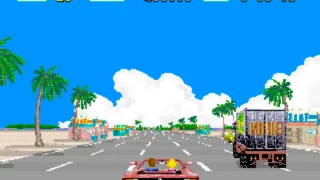
Ci sono stati tantissimi videogame arcade dedicati alla guida. Il più leggendario? Sicuramente Out Run
Apparso nel lontano 1986
Gioco arcade di genere “driving”, il cui gameplay era in larga misura basato su Night Driver, Pole Position e successive filiazioni, OutRun (アウトラン pron. “Autoran”) vide la luce nel 1986, partorito dal team “Studio 128” guidato dal geniale game designer Yu Suzuki che, per ben diciotto anni, fu alla testa Sega-AM2 (Sega Amusement Machine Research and Development Department 2). All’ormai leggendario Suzuki si deve la paternità di perle arcade quali Hang-On, Space Harrier e After Burner, nonché picchiaduro del calibro di Virtua Fighter e innovativi “action-adventure” come Shenmue. Il simulatore di guida Out Run, sviluppato dal gruppo per un hardware appositamente progettato, è considerato una pietra miliare nel suo genere.
Classificato dallo stesso Suzuki non già come “racing”, bensì come “driving game”, Out Run è stato portato su molte piattaforme domestiche di Sega sin dai tempi della sua versione originale arcade, incluse Master System e Genesis, e ha ispirato numerosi sequel. Fa parte di compilation pubblicate dalla casa madre, quali Sega Ages 2500, e appare in alcuni minigiochi arcade, in Shenmue II e in Yakuza0. Nel 2014, è stata pubblicata l’edizione 3D Out Run per Nintendo 3DS, una versione aggiornata dell’originale arcade con supporto 3D stereoscopico e altre innovazioni. Questa versione è stata poi utilizzata come riferimento per Sega Ages: Out Run su Nintendo Switch.
La scheda tecnica (grazie a Game Over Club)
BOARD COMPOSITION:
CPU Board (Main Board), Video Board[1]
Main CPU: 2× 68000 @ 12.5 MHz: 16/32‑bit instructions, 4.375 MIPS, 32‑bit (2× 16‑bit) data bus, 44‑bit (24‑bit, 20‑bit) address bus[2]
Memory Mapper FPGA: Sega 315‑5195 Memory Mapper @ 40 MHz: 16‑bit data bus, 24‑bit address bus[3][2]
SUONO
Sound CPU: Zilog Z80 @ 4 MHz (8/16‑bit instructions, 0.58 MIPS)
Sound chips: 2 chips, 24 channels, 24‑bit bus width[4]
FM synthesis chip: Yamaha YM2151 @ 4 MHz (8 FM channels, 8‑bit bus width)[5]
PCM sampling chip: SegaPCM 315‑5218 Sound Controller @ 4/16 MHz[1] (stereo output, 16 PCM channels, 12‑bit audio depth,[6] 31.25 kHz sampling rate, 16‑bit bus width)
Sound DAC: Yamaha YM3012 @ 4 MHz: 16‑bit floating‑point dynamic range[7]
Sound FPGA: Sega 315‑5223A (Signetics CK2605) @ 16 MHz: 8‑bit bus width[8][9]
GRAFICA
Video Board GPU: Sega 171‑5377 VIDEO Board graphics chipset @ 25.1748 MHz: 6 processors, 80‑bit RAM (167.521366 MB/s), 64‑bit ROM (37 MB/s)[1][3][4]
315‑5197 Sega Custom Tilemap Generator FPGA: 16‑bit RAM (15.384615 MHz, 65 ns, 30.76923 MB/s), 24‑bit ROM (4 MHz, 250 ns, 12 MB/s)
315‑5211 Sega Custom Sprite Generator FPGA: 16‑bit sprite attribute RAM (22.222222 MHz, 45 ns, 44.444444 MB/s),[10] 48‑bit sprite framebuffer RAM (15.384615 MHz, 65 ns, 92.307692 MB/s),[11] 32‑bit ROM (5 MHz, 200 ns, 20 MB/s)[12]
315‑5227A Signetics CK2678 PAL: 8‑bit ROM (5 MHz, 200 ns, 5 MB/s)[12]
315‑5228 Signetics CK2605 FPGA: 8‑bit[8][9]
315‑5242 Sega Custom Color Encoder: 16‑bit
8255‑2 NEC µPD8255AC‑2: 24‑bit (3× 8‑bit) PPI (Programmable Peripheral Interface)[13]
Main Board GPU: Sega 171‑5376 CPU Board graphics chipset @ 39.99967 MHz: 6 processors, 5‑bit RAM (6.25 MB/s), 16‑bit ROM (10 MB/s)[3][1][14]
2× 315‑5155 Sega Road Bit Extraction PAL: 16‑bit (2× 8‑bit), 2× 5 MHz ROM (200 ns, 10 MB/s)[12]
315‑5222 Signetics PLS153N Road Mixing FPGA: 8‑bit internal (33.333333 MHz),[15] 5‑bit RAM (10 MHz, 100 ns, 6.25 MB/s)
315‑5223A Signetics CK2605 FPGA: 8‑bit internal,[8][9] 4‑bit external
2× MMI PAL16R4 (315‑5225, 315‑5226) PAL: 16‑bit (2× 8‑bit)[16]
Fixed-point arithmetic capabilities: Z-buffering, depth map[17]
Video resolution: 320×224 (display), 400×262 (overscan),[1] progressive scan
Scanlines: 224 (display), 262 (overscan)
Refresh rate: 60.0543 Hz (V‑sync)[1]
Frame rate: 30–60.0543 FPS
Color palette: 98,304
16-bit color palette: 15‑bit RGB color depth (32,768 colors), 1‑bit shadow & highlight triples up to 98,304 colors
Colors on screen: 12,288[1]
Graphical planes:
2 tilemap layers
1 text layer
1 sprite layer
1 road layer
MEMORIA
Memory: Up to 3.6 MB (736 KB main, 2496 KB video, 454 KB sound)
RAM: 670 KB SRAM (Static RAM)[1][19]
Main RAM: 64 KB (32 KB per 68000)[20]
VRAM: 608 KB[1][4]